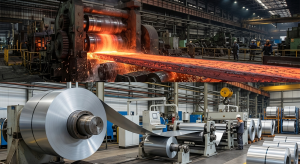
In today’s interconnected economy, the steel supply chain is no longer a local affair. For manufacturers in Bangladesh and beyond, the ability to source high-quality raw materials from international markets is a strategic necessity. Global sourcing doesn’t just provide access to materials; it dictates the speed, cost, and quality of industrial output.
At Metal Mart, we navigate the complexities of international trade to ensure that industrial supply chains remain resilient, even in the face of global market shifts.
1. Access to Specialized Material Grades
Not every steel mill produces the same quality or variety of metal. Global sourcing allows industries to tap into specialized production hubs.
- Precision and Quality: By sourcing from advanced mills in Japan and South Korea, manufacturers can access high-precision Cold Rolled Coils (SPCC/SAE 1008) that might not be available locally.
- Diverse Options: Whether it is Electro Galvanized sheets for electronics or Color Coils for specialized roofing, a global reach ensures that the exact technical specifications of a project are met without compromise.
2. Mitigation of Price Volatility
The price of steel is influenced by energy costs, mining output, and geopolitical events. A global sourcing strategy acts as a buffer against local price spikes.
- Competitive Sourcing: By monitoring markets in India, China, and Germany, procurement teams can shift their sourcing focus to regions where production costs are currently more favorable.
- Strategic Brokerage: At Metal Mart, our role as a trade broker is to identify these market windows, helping our clients secure bulk procurement at prices that protect their profit margins.
3. The Role of Letter of Credit (LC) and Financial Security
One of the biggest hurdles in global supply chains is financial risk. Securing a deal between a local buyer and a global producer requires a high level of trust and standardized financial instruments.
- Securing Transactions: The Letter of Credit (LC) is the backbone of international metal trade. It ensures that the supplier is paid only when the goods are shipped and the buyer receives exactly what was ordered.
- Operational Ease: By providing expert LC support, we remove the friction from the supply chain, allowing for a smooth flow of materials from international ports to local factory floors.
4. Lead Times and Logistical Coordination
Global sourcing introduces the challenge of distance, making logistics a critical component of the supply chain.
- Import/Export Coordination: Managing the timeline from the mill to the local warehouse requires precise coordination. Any delay at a port or in customs can halt production lines.
- Reliable Sourcing Networks: A well-managed global network ensures that shipping routes are optimized and that all materials arrive with the necessary mill certifications and compliance documents to avoid regulatory bottlenecks.
5. Enhancing Industrial Resilience
A supply chain that relies on a single source is vulnerable. Global sourcing introduces redundancy and flexibility.
- Strategic Joint Ventures: By building partnerships between global suppliers and local distributors, industries can create “buffer stocks” and shared infrastructure.
- Market Growth: For the Bangladesh industrial sector, this connectivity means the ability to scale production rapidly to meet both domestic demand and export opportunities.