In the world of industrial manufacturing and construction, steel is the backbone of progress. However, not all steel is created equal. The performance of your project often depends on a fundamental choice: Hot Rolled vs. Cold Rolled Steel.
At Metal Mart, we source both varieties from world-class mills in Japan, South Korea, and beyond. Understanding how these two processes differ is essential for choosing the right material for your specific application.
1. Hot Rolled Steel: The Foundation of Heavy Industry
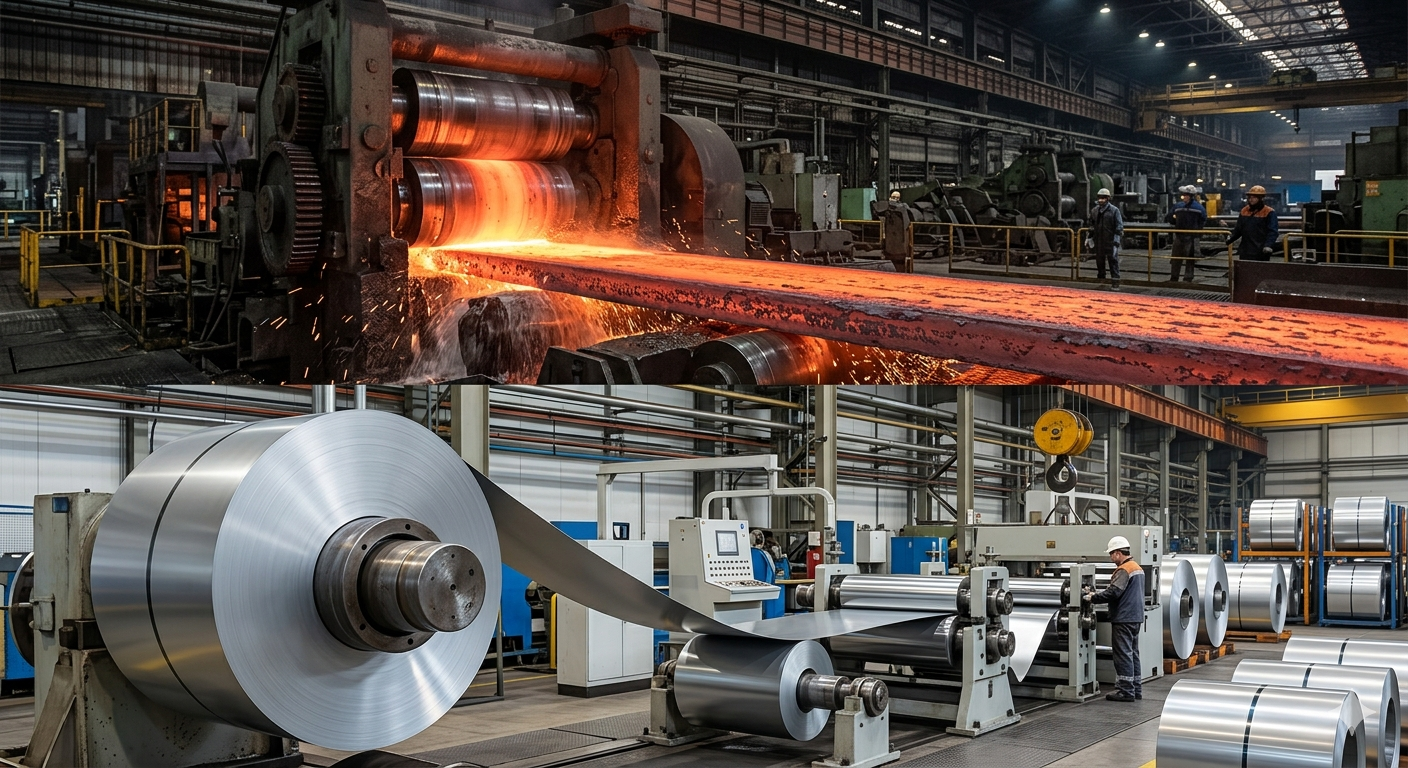
Hot rolling is a mill process where the steel is rolled at high temperatures—typically over 926°C. This temperature is above the steel’s recrystallization point, making the metal easier to shape and form.
- The Process: As the steel cools, it shrinks slightly, which gives the finished product less control over its ultimate shape and size compared to cold rolling.
- Appearance: It typically has a scaly, grey finish (known as mill scale) and slightly rounded edges.
- Best For: Structural components where precise shapes and tolerances are not critical, such as I-beams, railroad tracks, and agricultural equipment.
2. Cold Rolled Steel: Precision and Strength
Cold rolled steel is essentially hot rolled steel that has undergone further processing. Once the hot rolled steel cools, it is re-rolled at room temperature to achieve more exact dimensions and a better surface quality.
- The Process: By “working” the steel at lower temperatures, the material becomes harder and stronger through a process called strain hardening.
- Appearance: It features a smooth finish, sharp edges, and highly accurate dimensions.
- Best For: Projects requiring precision and aesthetics, such as home appliances, automotive parts, and aerospace components.
- Metal Mart Specialties: Our SAE 1008 and SPCC grades are prime examples of high-quality cold rolled steel used in precision manufacturing.
Key Differences at a Glance
| Feature | Hot Rolled Steel | Cold Rolled Steel |
| Processing Temp | Above recrystallization temp | Room temperature |
| Surface Finish | Rough and scaly | Smooth and refined |
| Tolerances | Looser | Very tight and precise |
| Strength | Lower (easier to form) | Higher (more resistant) |
| Cost | Generally more affordable | Higher (extra processing) |